John Proctor: Because it is my name! Because I cannot have another in my life! Because I lie and sign myself to lies! Because I am not worth the dust on the feet of them that hang! How may I live without my name? I have given you my soul; leave me my name!
I studied Arthur Miller's The Crucible for my Literature A Level and to be honest, compared to the splendour of Under Milk Wood and Richard III, my other set texts, I just didn't take to it. And what I particularly didn't get was John Proctor's refusal to sign his name to a confession of witchcraft in order to save his life. Surely, I thought at the time, it is only a name.
I've not given The Crucible too much thought since then. But it came into my head again this week when reading about the use of dead children's names for undercover officers in the Metropolitan Police. I've been surprised by how horrified I am by this, not least because I thought the country suffered a mass over-reaction to the Alder Hey organ scandal.
But I feel very strongly that the names we gave our children were a gift from us to them. As the language of the reporting of this case suggests, it is not just a name that has been stolen, but an identity. Their given names reflect their cultural heritage, their religious heritage, the age in which we live and our own taste and, no doubt, our class, and that's before their surname has been taken into account.
I don't buy into the need to choose a unique first name for children. Not for me made up names or unusual spellings. But I would be very very surprised if they shared their whole name with anyone else in the world, given they have an unusual surname with my surname as an extra given name. For it to be used by anyone else, be it a fraudster or the police, would be theft of something most precious. Add to that the fact that it's not just identity theft, but theft from dead children, and I find it all hugely abhorrent. Why? Because, as Arthur Miller knew, and I now know, it is their name.
Related post: What's in a name?
Addendum
I just emailed someone I used to know through work this week. She was convicted of a criminal offence that she says she didn't do. I asked how she was and whether her career was back on track. Her main concern, she said, wasn't her career or friendships, it was to clear her name.
Wednesday, 17 July 2013


Monday, 15 July 2013
Interview with Viv Groskop

The course was brilliant and I took another straight after, on comedy writing. Was I funny? Ish. Funny enough not to die on my arse at the few open mics I did in London and in New York when I spent a summer there and where, surprisingly, the comedy was far less sophisticated than it is in London, but nowhere near as funny as some of my classmates, particularly Rob Broderick and Judy Batalion, and from the writing class, Holly Walsh.
So I was particularly interested in the journalist Viv Groskop's adventure in comedy in which, after taking Logan's course, she decided to perform 100 gigs in 100 days. I wanted to know how such a challenge worked alongside being the parent of three children (I have two and frequently struggle to find time to brush my teeth) and its impact on her relationship, as well as how the actual gigs went and where her career, already one I admire journalistically, will go next.
Can you briefly tell me about the 100 day thing?
In the middle of 2011 I was trying to decide whether I should take stand-up more seriously or give it up completely. My third child was not yet one. I had done maybe 20 gigs, if that, over the course of 18 months. One morning I woke up and thought, "I know. I'll do 100 gigs in 100 nights. And then I will know within 3 months whether I should go on or give up." And the thought would not go away. So I waited for Jack (youngest child) to turn one and the day after his first birthday I did it.
I did Logan's course myself in 2004 and I really credit Logan's course with saving me emotionally - opening up a new interest and challenge and introducing me to new people. I wonder whether everyone who does it is searching for something new or running from something - it certainly seemed that way on my course. Was there any emotional impact for you?
I stumbled onto Logan Murray's comedy course almost by accident when a careers counsellor asked me the question, "What do you most want in your life that you don't have at the moment?" Without particularly meaning to say it, I answered, "Stand-up comedy." And I suddenly remembered that I had read about Logan's workshop. It seemed an incredibly stupid waste of time but I had paid the careers counsellor a lot of money and that meant I really had to listen to her advice. I signed up and the first day I came back and my husband said, "You are the most relaxed I have seen you in five years." You shouldn't really use those courses as therapy (if you need therapy, you should have therapy). But they pretty much work as therapy whether you intend them to or not.
Lots of comedians milk their own lives for jokes. Do you do this and do you worry about privacy issues for your kids? The same question goes for your journalism too.
I suppose I believe in being open without putting everything on display. I do write about my family and talk about them on stage but I try to do it in a controlled way. I think you can be honest without doing the full Liz Jones.
Do you think mothers often hide away their ambitions, either because their confidence is knocked or they just can't see a way to achieve it, and what gave you the impetus to actually go out and do it?
For me motherhood had the opposite effect. It boosted my confidence. Possibly the birth of my second child, my daughter, Vera, played a role in that. I had her in the kitchen at home next to the dishwasher and the midwife was only there in the last twenty minutes. It wasn't like I chewed through the umbilical cord with my teeth whilst holding the placenta aloft and screaming "I am the source and the power". But there was an element of that. After I had done that, I didn't really care that much about anything anymore. I think I realised pretty quickly after having children that if you are going to spend time worrying what other people think about you and the way you raise your children, you will not have a lot of time to actually do anything. So I made a decision to do what I wanted to do according to what I thought was right -- and let other people think what they want. It helps that my husband does a lot. There is no primary parent in our household. I know a lot of women who would never give up being the primary parent.
What did your husband think? And your children?
A lot of the book is about the challenge that our marriage faced as a result of me doing something that was pretty selfish that took me away from the house for nights on end. Even within a limited time frame (100 nights), it was tough. It wasn't so difficult for the children because I would usually be able to put them to bed and then go out. There were times during the experiment that I almost abandoned it because it was really awful for Simon.
Was it worth it?
It was worth it in terms of improving my comedy and getting an idea of whether I wanted to continue with it or not. (Spoiler alert: I did continue and am doing a solo show at Edinburgh for the first time this year -- at Funny Women Pop-Up Fringe on 18 and 19 August.) But whether it was worth it in a wider sense… It's hard to say. It was a massive challenge for any marriage. But I think sometimes you need to do something extreme in order to work out exactly where you stand.
I feel now I am a mum what happens at work is less important, because whatever happens I get home and I have my family. This actually makes me feel a bit invincible in the workplace - I don't care about office politics any more. Does that help when you die on your arse on stage?
Yes and no. I don't walk away from a bad gig thinking, "Oh, well, at least my children love me." I walk away, thinking, "Please let me just die quietly now." Maybe I should focus more on the love of my children…
What next?
I'm still plugging away on the amateur circuit, trying to get better at stand-up. I do a lot of MCing and I love that. I'm also in Upstairs Downton: The Improvised Episode, a cross between Downton Abbey and Whose Line Is It Anyway? in full period costume. (Also at Edinburgh -- at The Hive with Heroes of Free Fringe, 5pm, 1-25 August.)
I Laughed, I Cried: How One Woman Took on Stand-Up and (Almost) Ruined Her Life
I Laughed, I Cried: How One Woman Took on Stand-Up and (Almost) Ruined Her Life
Monday, 8 July 2013
More than memories
I've been sorting out baby clothes to be stored in the loft just in case we are crazy enough to try for a third. The everyday vests and babygros and buy on a whim Primark outfits (made by children for children?) I'm happy to pass on to anyone but the posher John Lewis dresses bought via eBay I'm saving to bestow upon favoured friends after my family is definitely complete.
I have however come across a couple of things that have tugged the heart strings and been put in the 'don't give away, ever' pile.
One of those is a bunny rabbit vest a friend bought my daughter as a present when she went into hospital for an operation as a baby. It says I heart Mummy on it. I say she bought it for my daughter, we both knew it was for me. And though I am usually resistant to slogans, any slogans, this one was just the right message at just the right time. I am not sure I could ever put another child of mine in it, it's so bound up with that time for me, but I don't want to give it away either.
At the other end of the spectrum is a yellow cardigan I bought for my son, though it has the opposite emotional tug and as soon as I found it I just needed it out of the house. I bought it full price, something I rarely do, in Mothercare, in a fit of concern that he'd only ever have hand me downs and never know the thrill of new clothes. As if his three month old self cared. I was also thrilled to find something for boys so bright and cheerful without a lion, dinosaur or car on it.
The first time he wore it he had a choking incident. It was over quickly, before I could ask my friend to call an ambulance I had held him upside down and was thwacking his back until he threw up monumentally and the colour drained back into his face, but all I can see now when I picture that cardigan is the bright yellow against a purple face struggling to breathe.
I don't even want to see that cardigan again on a friend's child, let alone my own, lovely as it is, so it's gone to a charity shop far enough away that I shouldn't bump into it again.
When my daughter was born my mum gave me a dress that had been my own as a baby. She had kept it in her box of special things. I took it out of the drawer one day to put it on my daughter and all the elastic had rotted in the intervening thirty-two years.
There are people online who make 'memory quilts' out of baby clothes for sentimental saddos who can't let go. You send them your fifty favourite items and a three figure bank transfer and they send you a bedspread covered in teddies, ducks, Breton stripe and knock off Scandinavian prints. I'm so going to get one made in due course, I just know it, with fabric from the one my mum passed down to me at the centre. I know it's vomit inducing and a little pathetic and will take fifty good outfits out of the hand me down circuit (perhaps it's even funded by clothes shops keen you buy as much new as possible), but I know too that I'll love it.
Tuesday, 25 June 2013
The bucket list
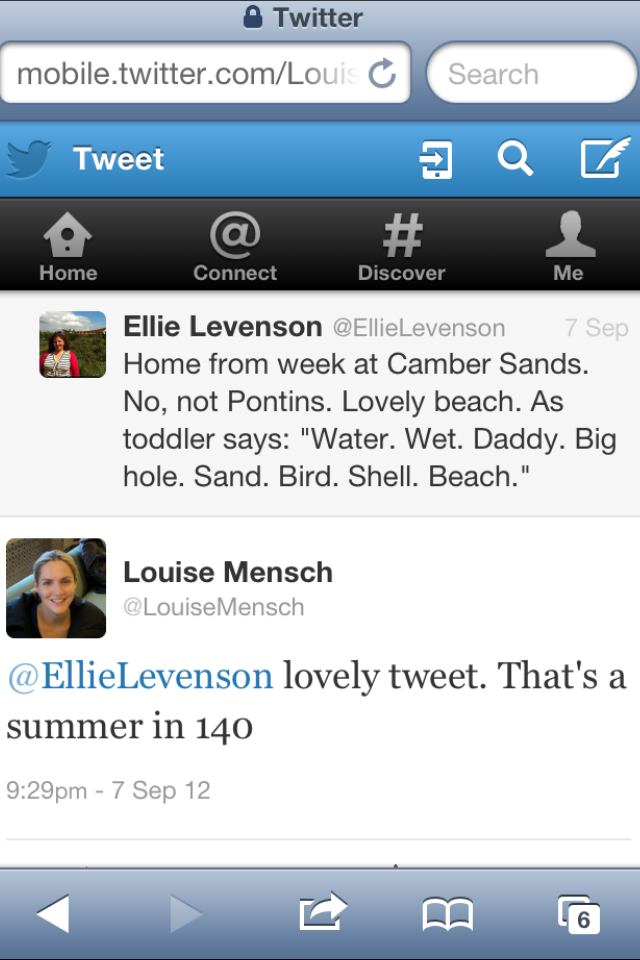
Say what you will about Louise Mensch and her politics, and much of the criticism of her smacks of misogyny to me (who cares about her roots being on show during Select Committee meetings?), I still think of her mostly as wildly successful chick lit author Louise Bagshawe. So I was thrilled when I tweeted last year about my summer holiday to have a response from her praising my tweet for its depiction of our holiday.
My oldest child is still only two but we have an impressive collection of buckets, spades and other beach toys. My favourites are a castle shaped bucket with wall attached so you can build a sand fort (castles are so last millennium) bought that holiday from a beachside stall, and an amazing builders set from Great Little Trading Company which includes a brick mould and spirit level (£17).

Our sand sculptures are ephemeral of course, the first wall or brick usually being kicked down before the second has been built, but I hope the memories they create last forever. Many of my memories of childhood are of our holidays. Many others however are based on food. In fact I remember day trips by what sweets we were bought (Highland toffee on the Isle of Wight, strawberry Fruitellas by the river at Broxbourne etc). I thought of these sweetie memories when pregnant with my son as I had a near constant craving for the first five months for Tooty Fruity sweets which it turns out are remarkably hard to find in north London (though Skittles scratched the itch temporarily when necessary). Sweets and beaches, that is how I remember my second pregnancy, and my childhood.
All of which is a very long way of getting to the main point which is never mind my holidays, never mind the sweets I crave, never mind my tweets, but look look look at these amazing, memory forming, castle and sweet treat combining, sandcastle ice cream buckets available from The Handpicked Collection (£5.95). I want some.

Saturday, 8 June 2013
Imagining
In 2000 my friend and I went backpacking. Although we, aged 21, thought we were being intrepid, we actually took a well trodden tourist route taking in India, Vietnam and Thailand.
There's a brilliant scene that makes up the prologue to Jonathan Coe's The Rotter's Club. Patrick and Sophie are talking about their parents' pasts, specifically 1973:
- Was it really that different do you think?
- Completely different. Just think of it! A world without mobiles or videos or Playstations or even faxes. A world that had never heard of Princess Diana or Tony Blair, never thought for a moment of going to war in Kosovo or Afghanistan. There were only three television channels in those days, Patrick. Three! And the unions were so powerful that, if they wanted to, they could close one of them down for a whole night. Sometimes people even had to do without electricity. Imagine!
I think of this scene when I think about backpacking in 2000, albeit with some revisions. We'd not only heard of Princess Diana, we'd started to forget her. People had mobiles, but not everyone. I got my own later that year so I could have it for the beginning of my journalism course. We used email, but I also still wrote letters. I hadn't yet performed a Google search (I learnt about Google on a computer skills module on the journalism course - imagine!) Phones certainly didn't send emails. Instead we stopped every week or so in an internet cafe and touched base with home, sending what we thought we witty group emails to all our friends with pithy observations about life in South East Asia.
In August 2000 we were in Thailand and heard about a cookery school in Chiang Mai in the north of the country. We decided to go for several days and before we left I called my mum and told her where we were heading.
As far as my mum knew Chiang Mai was a small village and we were the only tourists. In fact it is a big tourist hub with lots of hostels and visitors. Consequently when a couple of days later she heard on the radio that a young British female tourist had been found murdered in Chiang Mai, and that the name wouldn't be released until the family had been told, she had no way of contacting me. For a short while, until the name was released, she thought it was me. My grandpa, I am told, who I never saw have an alcoholic drink, had to sit down and have a whisky.
It was a day later I went to an internet cafe. Although we were in the same town we hadn't heard the news - I don't remember the detail but perhaps my friend and I had had an early night or went for dinner the two of us and didn't speak to other tourists. A deluge of emails from my mum was the first I knew of the murder, the last sent after she knew it wasn't me, asking for me to call her anyway. I did, and my poor mum managed not to ask me to return home early. We barricaded ourselves into our hostel room that night, my friend and I, and didn't go out in the dark.
The woman who was murdered was called Kirsty Jones. She was 23 and from Tredomen near Brecon.
I hadn't thought about those few days that much for the ten years after returning home. Then I had a child. And now I think of it almost every day. I think of my parents hearing the news and assuming the worst. I think of the day my kids are going to come home and tell me they've booked a round the world ticket. And most of all I think of Kirsty's parents having the worst confirmed, and of Kirsty herself.
Sunday, 7 April 2013
My application to work at Google

Dear Google HR department,
I have recently bought the book Are You Smart Enough to Work at Google? I have not had time to read it yet, as since becoming a mother I have only read a handful of books, but I fully intend to take it on holiday with me next month and to pretend things will be different because I am using the word holiday, and that I may have a chance to read.
Nevertheless I would like to apply to work at Google, specifically in a very senior position that earns googols of pounds.
I have much experience working as a writer, editor and lecturer, including writing two non fiction books and teaching at a prestigious university. However my application focuses on the experience gained during the two years since my daughter was born including the recent arrival of my son.
During this time I have developed excellent skills in project management. Every activity my family is involved with includes planning, organising and research to ensure completion on time and within budget, from working out journeys that facilitate naps to checking the availability of refreshments. This often involves balancing the competing requirements of the group.
I also have much experience in logistics, making sure people, facilities and supplies suit our requirements. This has included the planning of several holidays and travel on many modes of transport.
As leader of my team I frequently liaise with other team leaders to arrange activities that are both fun and educational. This includes assessing external settings and applying the criteria set by many interested parties and maintaining effective networks.
My communication skills have also developed in my current role. I already had much experience writing, editing and broadcasting. However I can now convey with a look, a twitch, a small intake of breath or a barely perceptible shake of the head whether something is allowed, whether it is dangerous and what level of punishment can be expected if I am disobeyed.
Crisis management has become one of my specialities. I am able to quickly assess any situation and go to the person or object most needing help whilst being aware of the speed in which other crises may be developing. Nothing fazes me, from overflowing sinks to precariously balanced irons or paint about to spill on the sofa.
I have daily responsibility for my team's budget, and can quickly evaluate the value of a carton of apple juice versus a box of raisins. I also now understand the value of a chocolate button, and the value of a cuddle. I also know the price of a 6 pint bottle of milk, and indeed the value (and cost) of 30ml of expressed breast milk.
Learning to delegate and to split tasks to ensure all members of the team feel involved in every project has been a key area for me. This sometimes requires changing the direction of a task in the middle of it. However I feel this is worth it to create a harmonious environment for everyone to work in.
I can assess danger in an instant, explain my decision and persuade all parties that they want to do things my way, regardless of the position they adopt at the start of proceedings. I have also become an expert negotiator and my skills in this area include knowing which battles to pursue and using all resources at my disposal when something just has to be done. A good example of this is convincing a two year old to brush her teeth.
In additon to this I often have to present progress reports on my work to other interested parties such as my husband and my parents, and to ensure a cohesive approach when using external contractors.
I have also acquired experience of interviewing and applying HR functions including hiring and firing. This has involved visiting several nurseries and deciding which best serves the needs of all parties.
All of my work seeks to meet short term goals whilst contributing to a long term strategy.
I am happy to expand on any of these points and very much look forward to hearing from you.
Kind regards,
Ellie Levenson
Mother
Tuesday, 2 April 2013
The importance of party bags
My daughter loves parties. She loves cake and singing happy birthday and, above all, she loves party bags. Parenting forums such as Mumsnet are often full of threads bemoaning the plastic tat you get in party bags and suggesting you give kids a book or donate to charity instead. Well my daughter loves plastic tat, as did I. Give her a pot of bubbles, a balloon and a plastic dinosaur and you'll have a special place in her heart. Not that she doesn't like books or do-gooding as well, but they don't really suit the frivolity or jollity of a party.
We went to a party yesterday. She went to bed talking about her party bag and woke up asking for it. We will make a special trip to the park this afternoon just to blow the party bag bubbles and chase them. Ah, the small, yet massive, pleasures, that make up a childhood.
It's things such as these that upset me most about the 'Bedroom Tax' and benefit cuts. Well that and denying people enough money to have housing and food and clothing. Those tiny things that me and George Osborne and Iain Duncan Smith probably think cost hardly anything, that we are making even harder for people on benefits to afford. A pot of bubbles. Birthday candles. A balloon. A day out to a museum with 50p to spend in the shop. An apple juice in the cafe after a run around the park. A present if you are invited to a birthday party. Just make a card you say? Sure - but how to afford the paper and crayons? A swim in the pool in the school holidays. The bus fare to go and see a friend. A magazine or comic that you have absolutely set your heart on. A piece of cake.
I don't go in for vouchers instead of money. Zoe Williams explains why perfectly in her column here. But even if you don't object to a voucher scheme, what would you do? A voucher for a candle? A voucher for a bubble?
That's the thing about this Government that strikes me even more than any other - they are not only anti-aspirational, using rhetoric about getting into work (what work?) and improving lives to actually make lives harder and dull any aspiration by removing the likelihood of achieving it, but they are actually preventing a whole generation of children from having what they and their own children take for granted, and should take for granted - the occasional thrills of an everyday party bag that to some is tat, but that is far far more precious than that.
Subscribe to:
Posts (Atom)